Here are the first 3 handouts for the French Revolution. I will add the rest as we go.
Link to French Revolution handouts
Showing posts with label Handout. Show all posts
Showing posts with label Handout. Show all posts
Wednesday, 23 April 2014

Handouts for English Civil War
If you have lost your notes sheets and need them to study, here are the ones from the English Civil War.
Link to Civil War handouts
Link to Civil War handouts
Sunday, 30 March 2014
Resilience Reader Responses
The following activity will be used for our resilience reader during silent reading on most days. Please follow the instructions in the doc.
https://docs.google.com/document/d/1dv08GOzFTIkCifUx-4P_R963XvzmUETn5QFuRqN1TE4/edit?usp=sharing
You will hand in a paper copy of the work you do for this activity. It will be due at the start of class the day after the assigned reading.
https://docs.google.com/document/d/1dv08GOzFTIkCifUx-4P_R963XvzmUETn5QFuRqN1TE4/edit?usp=sharing
You will hand in a paper copy of the work you do for this activity. It will be due at the start of class the day after the assigned reading.
Tuesday, 18 February 2014
Contact Sheet for Grade 3 Art
Please look at the contact sheet for the grade 3 art.
Contact Sheet Link
Your pictures in your storyboard should show a rough idea of what will be in each picture. Please write the number of the image you want to use in the text box area.
This should be done for homework if not finished in class.
Here is a good website telling you how to select an image in GIMP
http://www.gimp.org/tutorials/Changing_Background_Color_2/
Contact Sheet Link
Tuesday
Complete a storyboard for your book. The starred areas need to be complete. You do not have to copy out the full text for each square. You have two choices:- You print off your story. Using 2+ different colours, alternate underlining what goes on each page.
- Make a copy of your story in your assignment folder. Divide up using enter to show what is on each page. Print this out and hand it in with your storyboard.
Your pictures in your storyboard should show a rough idea of what will be in each picture. Please write the number of the image you want to use in the text box area.
This should be done for homework if not finished in class.
Here is a good website telling you how to select an image in GIMP
http://www.gimp.org/tutorials/Changing_Background_Color_2/
Thursday, 23 January 2014
Short Story Elements
These are the short story elements we will use in our stories.
Tone: The writer’s attitude towards the
subject or the audience.


Literary
Devices
Alliteration: the repetition of the same
sound at the start of several words. For example, “my mother makes marvelous
muffins.”
Imagery: descriptive language involving
multiple senses to make a word picture. For example, “The sharp crack of the
frost shattered the inky night air.”
Irony: when a statement or situation means
something different from (or even opposite of) what is expected.
Metaphor: an implied comparison of two things
that are not alike. The comparison suggests that they do share a common
quality. For example, “Her words were a knife to my heart.”
Mood: The feeling that the author wants the
reader to have.
Onomatopoeia: words that imitate
sounds. For example, Bang!
Oxymoron: a device that combines contradictory
words for dramatic effect, for example, jumbo shrimp.
Personification: When objects, ideas, or
animals are given human qualities. For example, “The sun smiled down on me.”
Simile: A direct comparison between unlike
things using the word “like” or “as” to connect them. For example, “Potatoes
are like apples of the earth.”
Stereotypes: an oversimplified
picture, usually of a group of people, giving them all a set of
characteristics, without consideration of individual differences.
Thursday, 7 November 2013
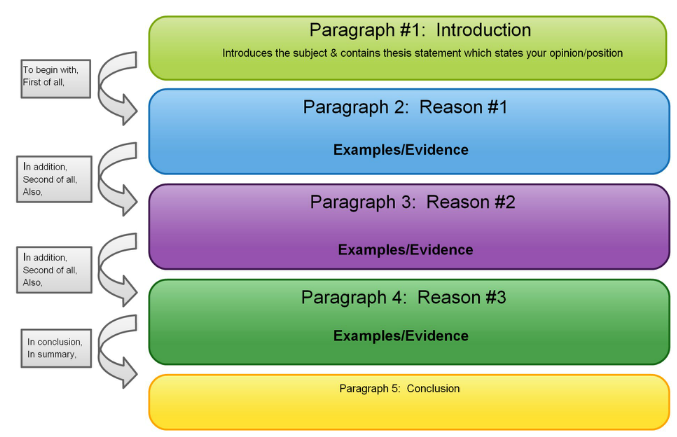
Persuasive Essay Format
This is the format we have decided to use:
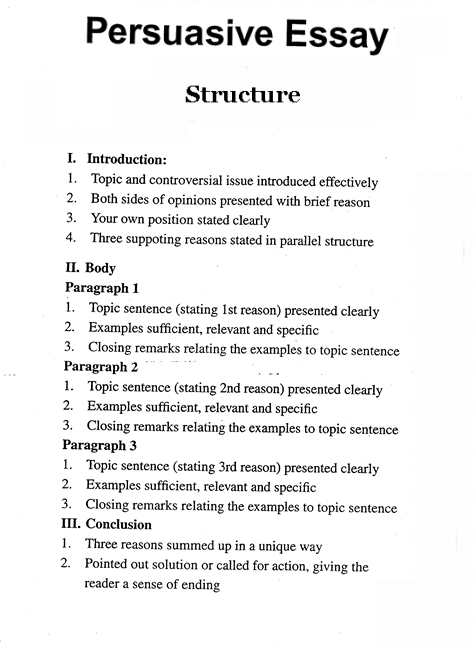
This is the format of the essay in general terms:
Subscribe to:
Posts (Atom)